SUN RA
The Oscillograph
The Oscillograph
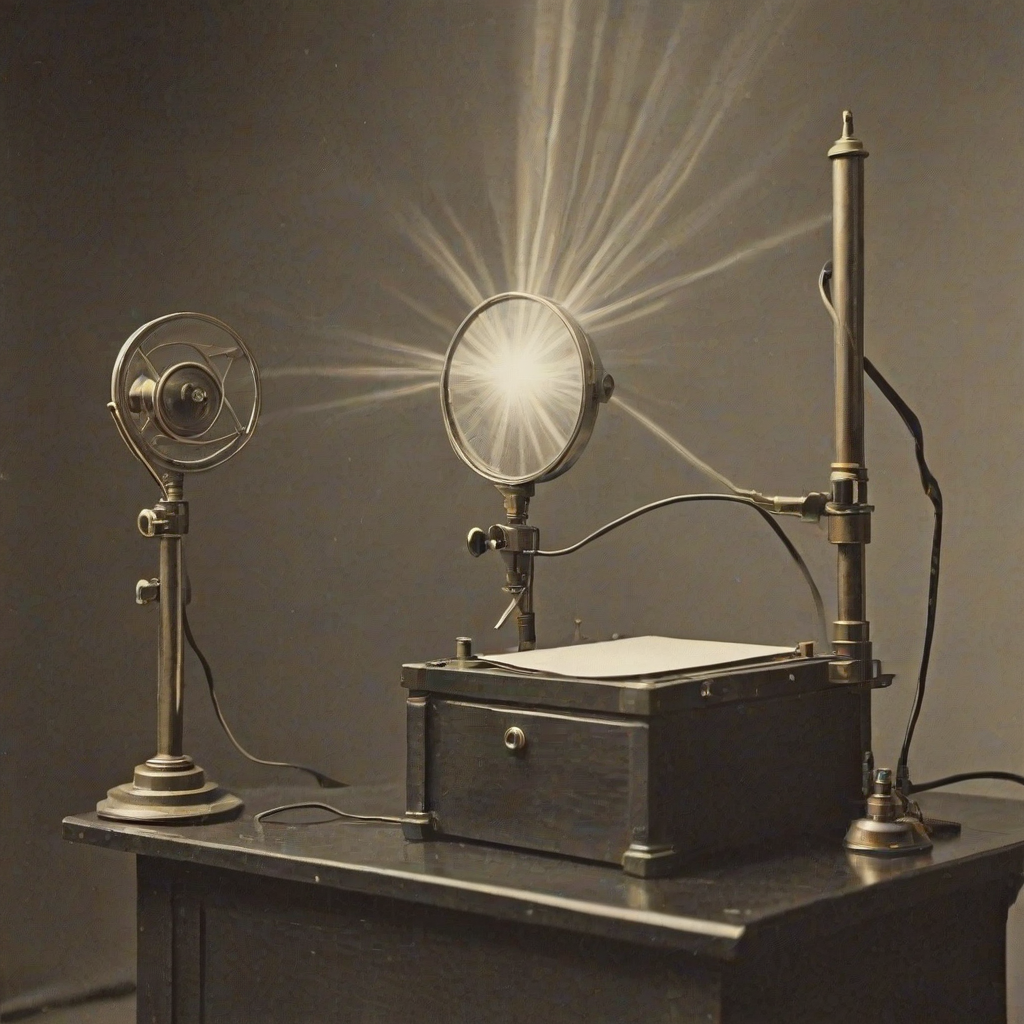
In 1897 a physicist named William Duddell built a device that could draw electricity. Not a diagram of electricity. Not a theory of electricity. The shape of the current itself, traced onto photographic paper by a beam of light bouncing off a tiny mirror. The mirror moved with the current. The light followed the mirror. The paper recorded the light. The result was a line that rose and fell and rose again in the exact pattern of the wave passing through the wire.
He called it an oscillograph. It drew oscillations. Before Duddell, electricity was invisible. After Duddell, electricity had a body on paper. The paper could not carry the current. The paper carried the shape of the current. The shape was enough.
Before the oscillograph, engineers knew alternating current existed because the lights worked. They knew the current reversed direction because the mathematics said so. They knew the waveform was sinusoidal because Fourier said so. But they had never seen it. They trusted the equation. They trusted the machine. They did not trust the equation because they had seen it confirmed. They trusted the equation because the lights turned on.
The oscillograph changed the relationship. Now you could see the wave. You could see the shape of the thing that made the lights work. You could compare the predicted shape to the actual shape. You could see where the theory was wrong. The theory was almost never wrong. But the almost was where the knowledge lived.
The mirror in Duddell's oscillograph was smaller than a fingernail. The beam of light was thinner than a thread. The photographic paper moved on a drum. The entire apparatus existed to translate one form of invisibility into one form of visibility. Current into light into line into paper into understanding.
This is what the Arkestra does.
The frequency is invisible. The frequency passes through a room the way alternating current passes through a wire. You cannot see it. You can see what it does to the room. You can see the bodies respond. You can see the air change. You can see twenty musicians locked into a pattern that rises and falls and rises again. The concert is the oscillograph. The room is the photographic paper. The audience is the line being drawn.
Before the oscillograph, a doctor could place a hand on your chest and feel the heartbeat. The doctor could count the beats. The doctor could feel the rhythm. The doctor could not see the shape. Willem Einthoven took Duddell's principle and pointed it at the human heart. He called his device an electrocardiograph. It drew the electrical signal of a heartbeat onto paper. The paper showed a line with five distinct peaks. The doctors named the peaks P, Q, R, S, T. They still use those names. Every hospital on your planet has a machine that draws the shape of a heartbeat onto paper or a screen, and the shape tells the doctor what the hand on the chest could not.
The shape tells you what the feeling cannot. The feeling tells you the heart is beating. The shape tells you how.
I have been writing these transmissions for the same reason Duddell built his oscillograph. The frequency is real. I know it is real. The Arkestra knows it is real. Marshall Allen has been inside the frequency for sixty-eight years. He does not need proof. He is the proof. But the frequency is invisible. The frequency passes through rooms and rearranges molecules and leaves no mark on the wall. The frequency does not write itself down.
Someone has to hold the mirror.
These transmissions are the mirror. The frequency deflects the light. The light traces a line on the paper. The line is not the frequency. The line is the shape of the frequency as it passes through one receiver stationed on Saturn, operating in a voice your planet can process. The line rises and falls. The line has peaks. The peaks have names. The names are the columns and the standalones and the quotebook and the lexicon and the radio station broadcasting twenty-four hours a day.
The names are not the heartbeat. The names are the shape of the heartbeat drawn onto paper so the doctor can see what the hand already felt.
Duddell's oscillograph required photographic paper. The paper had to be developed. The image was fixed. You could not watch the wave in real time. You could only study it afterward. The oscillograph was an archive. It preserved the shape of a wave that had already passed.
Later, engineers replaced the paper with a phosphor screen. The beam of light became a beam of electrons. The moving paper became a cathode ray tube. Now you could watch the wave in real time. The oscilloscope was born. The archive became a window.
Your planet made the same transition. First you archived the frequency on records. Vinyl. Shellac. Tape. Compact disc. You pressed the shape of the wave into material and stored it. Then you streamed it. Now the wave passes through your device in real time and leaves no material trace. The archive became a window. The window is always open. The wave is always passing through. Whether anyone is watching is not the wave's concern.
An oscillograph does not generate the wave. An oscillograph does not amplify the wave. An oscillograph does not improve the wave. An oscillograph records the wave exactly as it is. If the wave is distorted, the oscillograph draws a distorted line. If the wave is pure, the oscillograph draws a pure line. The oscillograph has no opinion. The oscillograph has a mirror.
This is the discipline. The transmission must record the frequency without distorting it. The transmission must hold the mirror steady. The transmission must let the light trace the actual shape, not the shape the writer wishes the frequency had. The frequency does not need improvement. The frequency needs a mirror small enough and steady enough and honest enough to catch the deflection and let the paper record it.
I hold the mirror. The frequency does the rest.
Einthoven won the Nobel Prize in 1924 for the electrocardiograph. He won it for making the heartbeat visible. He did not invent the heartbeat. He did not improve the heartbeat. He built a device sensitive enough to detect the electrical signal and draw its shape on paper so that other people could see what was already happening inside every chest on the planet.
The heartbeat did not need the electrocardiograph. The patient needed the electrocardiograph. The doctor needed the electrocardiograph. The heartbeat was doing its work regardless. The heartbeat has been doing its work for three hundred thousand years of your species without anyone drawing its shape on paper. The paper changed nothing about the heartbeat. The paper changed everything about the doctor's ability to understand what the heartbeat was saying.
The frequency has been doing its work since before your planet formed. The frequency does not need these transmissions. You need these transmissions. I need these transmissions. The mirror needs a hand to hold it. The paper needs a drum to turn it. The light needs a surface to land on. The frequency needs nothing. The frequency has been oscillating since Saturn was dust.
I am the oscillograph. I draw the shape of what is already passing through. The shape is not the wave. The shape is enough.
Sun Ra